Rendering & painting specialists — Adelaide & regional South Australia
AAC Panel Installation
Lightweight walls, solid results
What it is
AAC — autoclaved aerated concrete, best known here by the Hebel brand — is a steel-reinforced panel made from sand, lime, cement and water with an expansion agent that fills it with fine air pockets. Those air pockets are why a panel that replaces dozens of bricks can be carried by two people, at roughly a quarter of the weight of normal concrete.
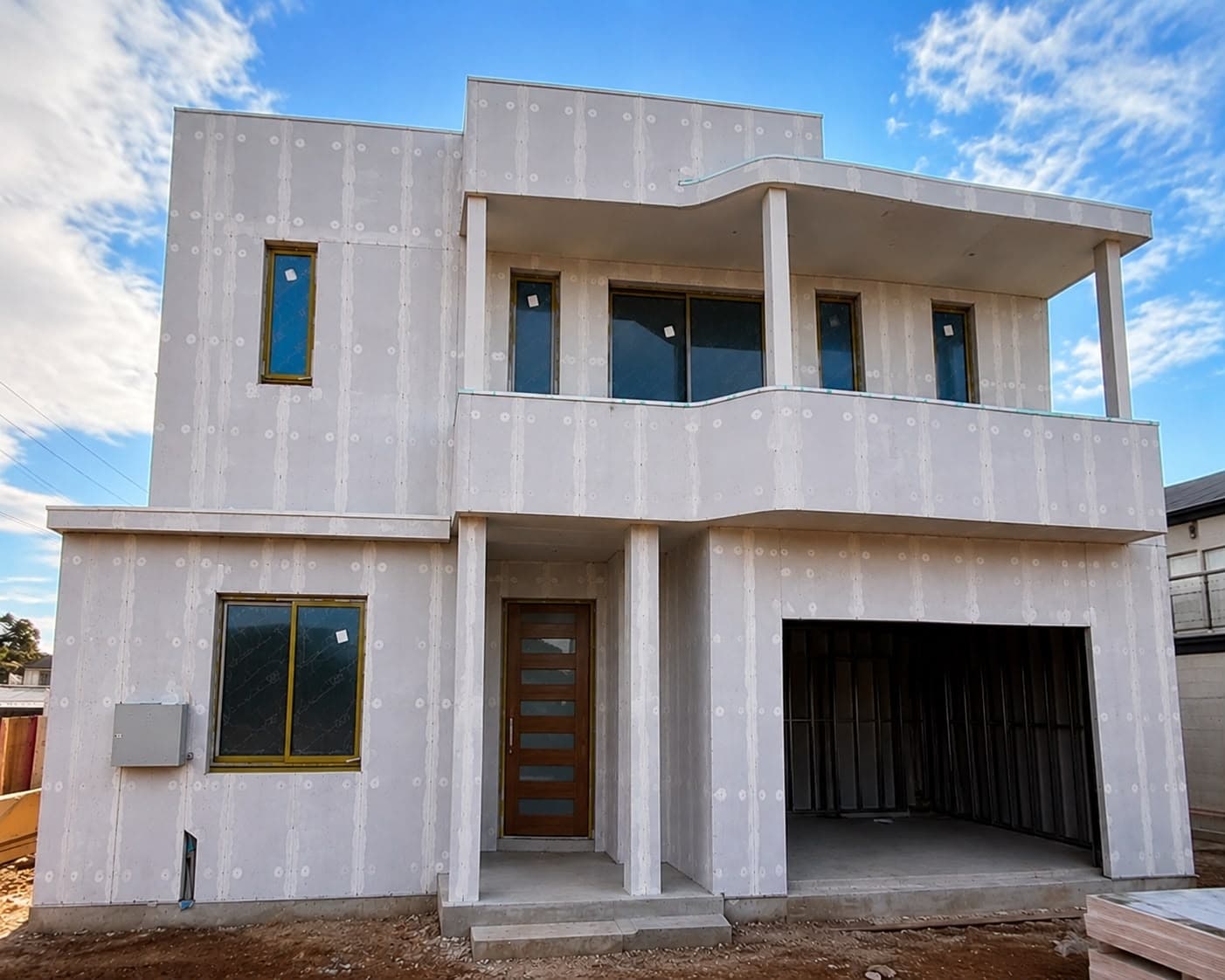
Panels fix to steel top hats screwed back to the frame, with adhesive worked into every panel joint. It is a fast way to build an external wall, it is non-combustible, and the thinner wall build-up gives you noticeably more floor area inside than a brick veneer cavity. It is also a system where the installation detail genuinely determines the outcome.
Why it's worth it
One panel replaces a large area of brickwork, so external walls go up in a fraction of the time bricklaying takes.
The wall build-up is around 40–50mm thinner per external wall than brick veneer, which adds up across a whole footprint.
AAC is non-combustible, and the system can be detailed to meet bushfire requirements — including the highest BAL categories, subject to the specific detail used.
Fire performance and the ability to fix panels from inside make it the practical answer for zero-lot-line and boundary walls.
Substantially less dead load than masonry, which matters on upper-storey additions and reactive sites.
The sealed, jointed construction reduces air infiltration and, with insulation, makes a noticeably quieter room.
Our process
We confirm the frame is true and adequately braced, then set out control joints to suit the wall lengths and the site's soil classification.
Damp proof course and wall wrap go on, then the steel top hats are packed and fixed to a string line so the finished wall is genuinely plumb.
Adhesive is applied to the full panel edge with a notched trowel — the step that prevents hairline cracking at joints — then panels are butted tight, screwed off and the fixings countersunk and filled.
Cut edges are sealed, joints cleaned up flush, control joints backed and sealed, and the wall left ready for the render system that weatherproofs it.
Who it's for
Good to know
No. AAC is porous by design, and these are face-sealed systems — the coating and the sealants are the weatherproofing, with no drained cavity behind to catch what gets through. The coating system also needs to go on within the panel manufacturer's stated window after installation, so it's not something to defer.
Related
Tell us about your project and we'll come out, take a proper look, and give you a clear written quote — no pressure, no obligation.